




Everybody’s mouth, teeth, gums and brushing techniques are different. So why, then, are most toothbrushes designed in a one-size-fits-all fashion?
When selecting a toothbrush, don’t just grab the first one you see in the drugstore aisle. Take a moment to think about which one will best fit your personal needs.
When you find the right toothbrush for you, you’ll be amazed at the difference it makes. Here are a few key considerations to help you find the best fit for you:
EFFECTIVENESS
A truly effective toothbrush should be able to remove plaque and other food debris that contribute to tooth decay without causing unnecessary damage to the delicate tissues of the gum. Medium and hard bristles push back the gum margins (where gum and tooth meet) exposing tooth surfaces, increasing sensitivity and causing irreparable damage including periodontal disease and cavities.
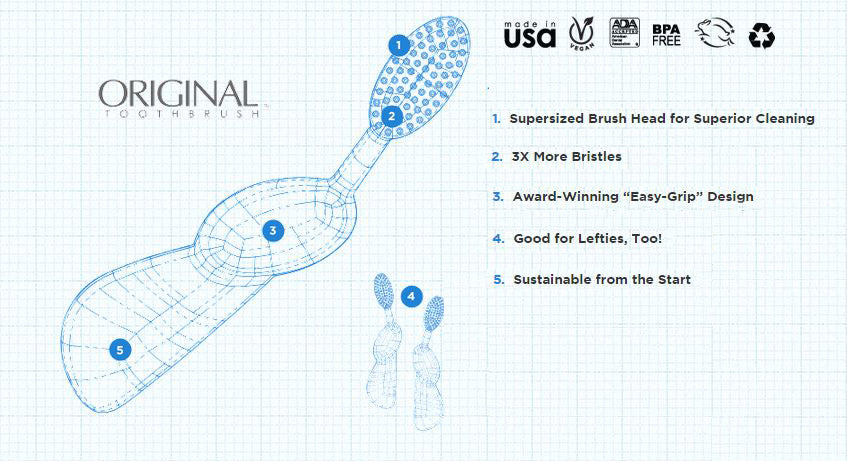
RADIUS® knows the best and most gentle way to clean is with softer bristles, which is why all of our toothbrushes are adorned with finer, longer, softer and more pliable bristles that reach every nook and cranny of your mouth without aggravating the gum line.
COMFORT & CONTROL
We believe a toothbrush is no good if using it doesn’t feel good.
Making toothbrushes that provide a cleaning experience worth savoring is what we live for, because the bottom line is, when brushing becomes a pleasure not a chore, you’ll naturally start taking better care of your teeth.

|
Our toothbrushes don’t just clean your teeth. The softer bristles and unique brush head design massage and invigorate your entire mouth. And the smart handles are meticulously crafted for the perfect grip and reach. Whether you’re one year old or 100, left or right handed, a vigorous brusher or a light touch — the RADIUS toothbrush provides you with a more customized and comfortable brushing experience for life. |
DESIGN
The architects who designed the RADIUS range of toothbrushes are professional sticklers for elegant design. Their unique aesthetic is more than a reflection of functionality — it’s a style statement. After all, you use your toothbrush twice a day, so why not feel a little more fabulous when you do?

As effective as they are beautiful, our unique products are defined by bright, bold colors and delightful details. In short, RADIUS products don’t just work better, they look nicer too. We want you to love them, because the more you love them, the more you’ll use them.
ADA ACCEPTANCE
Did you know, ever since The American Dental Association (ADA) Seal of Acceptance program began in 1931, toothbrushes in America have undergone a thorough screening process by the ADA?
Manufacturers voluntarily submit their products for testing by ADA laboratory staff, who evaluate them with the help of more than 150 scientists — experts in dental materials, microbiology, pharmacology, toxicology, and chemistry.
What are they looking f
or?

|
|
More Good to Know:
Learn why soft bristles are important
Is the RADIUS Totz® toothbrush ADA Accepted?
Yes. The Totz® Brush carries the American Dental Association Seal of Acceptance, which means the ADA reviewed it for safety and effectiveness in children and found the claims on the package supported by evidence. It is designed for little mouths, with extra-soft bristles and a wide, easy-to-hold handle, and it is BPA-free.
If you are standing in an aisle or scrolling a product page and want a quick check, look for the ADA Seal printed directly on the packaging. Acceptance applies to a specific product, not to a whole brand, so a company can have some brushes that carry the seal and others that do not.
[NEEDS: confirmation of the exact ADA-Accepted product names and the age ranges each is accepted for — Totz®, Totz® Plus, and any adult models — pulled from current packaging or the ADA product listing, so nothing is claimed here that is not on file.]
The rest of this guide covers what the seal actually means, how to verify it yourself, and what to weigh once you have narrowed the field to brushes that carry it.
How to tell if a toothbrush is ADA approved
The phrase most people use is "ADA approved," though the official wording is "ADA Accepted." Either way, there are three reliable ways to check, and none of them require guesswork.
- Look for the Seal on the package. Accepted products are permitted to display the ADA Seal of Acceptance directly on the box or blister card. If it is not printed there, the product almost certainly does not hold it. - Check the ADA's own searchable list of Accepted products. Acceptance is granted product by product, so search the exact model name rather than the brand. - Read the claim carefully. "Dentist recommended" and "clinically proven" are marketing phrases anyone can print. "ADA Accepted" is not.
One more thing worth knowing: participation is voluntary. A toothbrush without the seal is not automatically a poor brush, it may simply mean the manufacturer never submitted it. The seal tells you a product has been reviewed, not that unreviewed products have failed.
Acceptance also has an expiration and renewal cycle, so a product's status can change over time. That is why checking the current listing beats relying on an old photo or a third-party marketplace description.
Which toothbrushes are ADA Accepted, and how to choose among them
Because the seal is awarded to individual products, the honest answer to "which toothbrushes are ADA Accepted" is: a long and changing list across many brands, including manual, powered, and children's brushes. The seal sets a floor, not a ranking. It tells you a brush is safe and does what it says. It does not tell you which one suits your mouth.
That is where the earlier sections of this guide do the real work. Once you are choosing between accepted brushes, the deciding factors are bristle softness, head size, handle grip, and your brushing style. Someone who scrubs hard needs a different brush than someone with a light touch, and anyone with tender gums should be looking for a toothbrush that is gentle yet effective rather than simply firm.
A short way to narrow it down:
- Bristles: soft or extra soft, always. Medium and hard bristles offer no cleaning advantage and are rougher on the gum line. - Head size: small enough to reach the back molars comfortably. - Handle: wide and grippy for children and for anyone with limited hand strength. - Age fit: children's brushes are accepted for specific age ranges, so match the brush to the child rather than sizing up early.
Brushing is only part of the routine, of course. Pairing your brush with the right floss covers the surfaces bristles were never going to reach on their own.